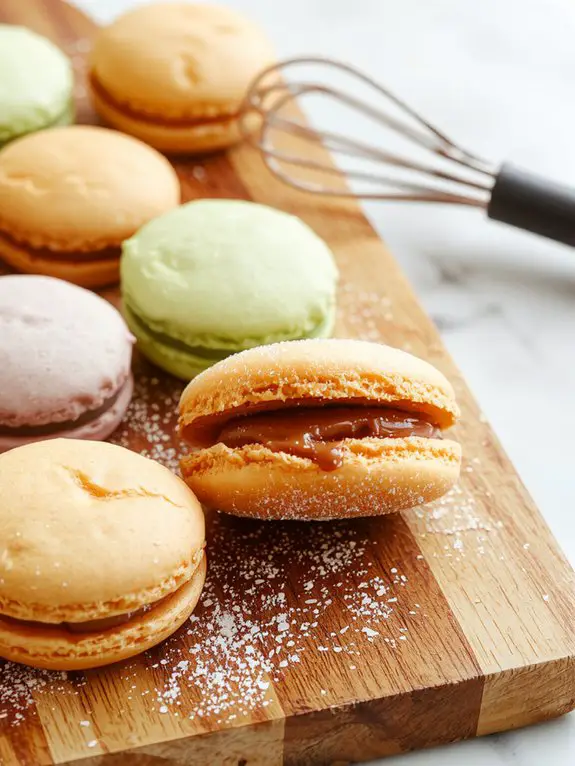
The Best Homemade Macaron Recipe

Recipe
Let me tell you—this homemade macaron recipe is the ultimate game-changer. I’ve perfected it over countless batches, and the results are nothing short of magical.
With just a handful of simple ingredients—almond flour, powdered sugar, egg whites, and a touch of patience—you’ll create delicate, airy shells with that signature crisp exterior and chewy center.
The secret? Whipping the egg whites to just the right consistency and mastering the macaronage technique to achieve that smooth, shiny batter.
Whether you fill them with ganache, buttercream, or jam, every bite is a symphony of flavors and textures that’ll make you feel like a pastry pro.
Trust me, once you nail these, you’ll be the star of every bake sale, potluck, or lazy Sunday treat session. Ready to impress? Let’s get baking!
Ingredients
Obtaining the appropriate ingredients is vital for flawless macarons—this delicate treat demands precision, but with a few insider tips, you’ll nail it.
- Almond flour: Use finely ground for a smooth shell. Sift it well to avoid clumps—this is non-negotiable for that professional finish.
- Powdered sugar: Helps create the signature texture. Sift it alongside the almond flour for a silky batter.
- Egg whites: Fresh and room temperature is key. Avoid any traces of yolk—it’ll ruin the meringue.
- Granulated sugar: Adds structure to the meringue. Superfine sugar dissolves faster, guaranteeing a stable mixture.
- Cream of tartar (optional): Helps stabilize the meringue, especially on humid days. A pinch goes a long way.
- Food coloring (optional): Gel-based works best—it doesn’t alter the batter’s consistency.
Pro Tip: Weigh your ingredients! Macarons are finicky, and weighing guarantees precision.
For a twist, try swapping almond flour with pistachio or hazelnut flour for a unique flavor.
How to Make the Best Perfect French Macaron Recipe
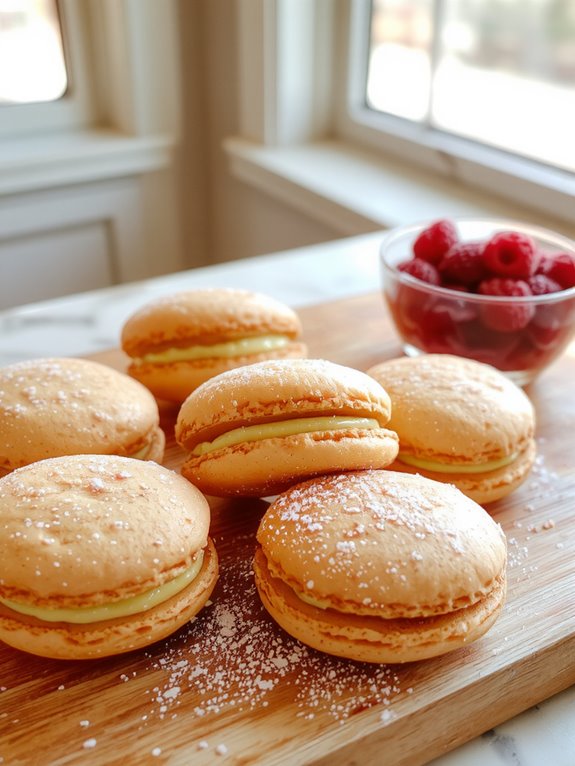
Prepare the Ingredients
Measure all ingredients precisely using a kitchen scale for accuracy.
Sift the almond flour and powdered sugar together into a large bowl to guarantee a smooth, lump-free texture.
Pro Tip: Use a fine-mesh sieve for best results.
Watch out: Even small lumps can ruin the macaron’s delicate surface.
Whip the Egg Whites****
In a clean, dry bowl, beat the egg whites on medium speed until frothy.
Gradually add granulated sugar and continue whipping until stiff, glossy peaks form.
Visual cue: The meringue should hold its shape when you lift the whisk.
Pro Tip: Wipe the bowl and whisk with vinegar to remove any grease, which can prevent the egg whites from whipping properly.
Fold in the Dry Ingredients
Gently fold the sifted almond flour and powdered sugar into the meringue using a spatula.
Use a figure-eight motion to combine until the batter flows like lava—thick but smooth.
Pro Tip: Overmixing will make the batter too runny; undermixing can cause cracks.
Visual cue: The batter should ribbon off the spatula and disappear back into itself in about 10 seconds.
Pipe the Macaron Shells
Transfer the batter to a piping bag fitted with a round tip.
Pipe small, even circles onto a parchment-lined baking sheet.
Tap the sheet firmly on the counter to release air bubbles.
Pro Tip: Use a template under the parchment to confirm consistent sizing.
Watch out: Air bubbles can cause hollow shells.
Rest the Shells
Let the piped macarons sit at room temperature for 30–60 minutes, or until a skin forms on the surface.
Visual cue: The shells should feel dry to the touch and not stick to your finger.
Pro Tip: Humidity can affect resting time; avoid making macarons on rainy days.
Bake the Macarons
Preheat the oven to 300°F (150°C).
Bake the macarons on the middle rack for 12–15 minutes.
Visual cue: The shells should have risen slightly and formed “feet” at the base.
Pro Tip: Rotate the tray halfway through baking for even heat distribution.
Watch out: Overbaking can make the shells brittle.
Cool and Assemble
Let the macaron shells cool completely on the baking sheet before removing them.
Pair similar-sized shells and fill with your choice of buttercream, ganache, or jam.
Pro Tip: Let the filled macarons rest in the fridge for 24 hours for the best texture.
Watch out: Filling the shells while they’re still warm can cause breakage.
Nutrition
Macarons are delicate French cookies with a crisp shell and chewy interior. While indulgent, they can be part of a balanced diet in moderation.
| Nutrition Facts | Per Serving (1 macaron) |
|---|---|
| Calories | 70 |
| Total Fat | 3g |
| Saturated Fat | 1g |
| Cholesterol | 10mg |
| Sodium | 15mg |
| Total Carbs | 10g |
| Sugars | 8g |
| Protein | 1g |
Chef Tips
Though macarons may seem intimidating to make, I’ve found that a few key techniques can make all the difference. Always sift almond flour and powdered sugar to avoid lumps.
Whip egg whites to stiff peaks and fold batter gently to preserve air. Pipe evenly sized circles and tap trays to release air bubbles.
Rest shells before baking to form a skin. Perfecting these steps guarantees smooth, delicate macarons.
Frequently Asked Questions
How Long Do Macarons Last?
Macarons last about 3-5 days at room temperature if stored in an airtight container. I keep mine in the fridge for up to a week—just let them come to room temperature before eating for the best texture.
Can I Freeze Macarons?
Yes, I can freeze macarons. I wrap them tightly in plastic wrap, place them in an airtight container, and freeze for up to three months. When I’m ready to eat them, I thaw them in the fridge overnight.
Why Did My Macarons Crack?
Your macarons cracked because I overmixed the batter or didn’t let them rest long enough before baking. Uneven oven heat or too much moisture can also cause cracks. I’ll double-check my technique next time.
Can I Use Almond Flour Substitutes?
I can use almond flour substitutes like hazelnut or pistachio flour, but they might change the texture and taste. If I swap it, I’ll need to adjust the recipe carefully to avoid affecting the macaron’s structure.
How Do I Store Macarons?
I store my macarons in an airtight container in the fridge for up to a week. If I want them to last longer, I freeze them—they’ll stay fresh for a month. Just thaw before serving.